
Turkish delight recipe: homemade lokum with rosewater
Lokum, the sweet the English-speaking world calls Turkish delight, is one of the simplest confections there is: sugar, water and starch, cooked slowly until they turn into a soft, springy jelly, flavoured with rosewater and rolled in icing sugar. Good lokum is tender and chewy rather than rubbery, and it melts slowly. It is offered to guests with coffee, packed into boxes as gifts and taken home by every visitor to Istanbul.
Its old Ottoman name, rahatü’l-hulkum, comes from the Arabic for “comfort of the throat”; the everyday name lokum came later. The Wikipedia entry on Turkish delight covers its long history, from Byzantine and Persian starch sweets to the Istanbul confectioners who made it famous. Making it at home takes time and stirring, but the result is fresher and more fragrant than anything in a box.
What is lokum?
Lokum is a gel made by cooking sugar syrup with starch until it is very thick, then letting it set. It is traditionally flavoured with rosewater, mastic, lemon or orange, and often studded with pistachios or hazelnuts. The commercial product rahatü’l-hulkum is known from the 17th century.
Hacı Bekir and Istanbul
The Istanbul confectioner Hacı Bekir says its founder, Ali Muhiddin Hacı Bekir, came to the city from Kastamonu and opened a shop in Bahçekapı in 1777. The company credits him with inventing lokum, but the Oxford Companion to Food finds no real evidence for that, and Persian sweets of starch and sugar were being made centuries earlier.
Turkish delight in Britain
Turkish delight has a long history in Britain too. Fry’s Turkish Delight, rosewater jelly covered in milk chocolate, was launched in 1914, and C. S. Lewis made it the White Witch’s enchanted sweet in The Lion, the Witch and the Wardrobe (1950). The Wikipedia overview of Turkish cuisine notes that in Ottoman times lokum was eaten after meals to help digestion.
Ingredients
Makes about 49 pieces in a 20cm square tin.
For the syrup
- 800g granulated sugar
- 250ml water
- 1 tsp lemon juice
For the starch mixture
- 120g cornflour
- 1 tsp cream of tartar
- 700ml cold water
To flavour and finish
- 2 tbsp rosewater
- 2 to 3 drops red or pink food colouring (optional)
- 50g shelled pistachios (optional)
- Sunflower oil, for the tin
- 3 tbsp icing sugar mixed with 3 tbsp cornflour, for dusting
How to make lokum
1. Prepare the tin
Line a 20cm square tin with cling film or baking paper, brush it lightly with oil and dust with some of the icing sugar and cornflour mixture.
2. Boil the syrup
Put the sugar, water and lemon juice in a heavy pan and heat, stirring, until the sugar dissolves. Then stop stirring and boil until the syrup reaches 115°C on a sugar thermometer, about 15 to 20 minutes. Take it off the heat.
3. Cook the starch
Meanwhile, in a large, heavy saucepan, whisk the cornflour and cream of tartar into the 700ml cold water until smooth. Cook over a medium heat, whisking constantly, until it turns into a thick, glossy, gluey paste, about 5 minutes.
4. Combine slowly
Pour the hot syrup into the starch paste a ladleful at a time, whisking well after each addition so there are no lumps. Once it is all in, the mixture will be thin and cloudy.
5. Cook low and long
Turn the heat to low and let the mixture bubble gently for 60 to 90 minutes, stirring every 5 minutes with a heatproof spatula, scraping the bottom. It will slowly turn from milky white to a clear, pale golden colour and become very thick. It is ready when it pulls away from the sides of the pan and a spoonful dropped onto a cold plate sets into a firm blob.
6. Flavour and set
Off the heat, stir in the rosewater, the colouring and pistachios, if using. Pour into the tin and smooth the top. Leave uncovered at room temperature for at least 12 hours, or overnight, to set. Do not refrigerate.
7. Cut and dust
Turn the slab out onto a board dusted with the icing sugar mix. Cut it into seven strips each way (a little under 3cm) with an oiled knife and toss each piece in the dusting mixture.
Watch: how to make lokum
This video shows how the syrup and starch come together and how thick the mixture should get.
Tips for the best lokum
- Use a sugar thermometer for the syrup. Guessing is the most common reason lokum fails to set.
- Do not rush the slow cook. Lokum taken off the heat too soon stays sticky and runny.
- Use a heavy-based pan and keep the heat low; the mixture catches easily as it thickens.
- Add rosewater at the end, off the heat, or the fragrance cooks away. Brands vary in strength, so taste and add more if needed.
- Store lokum in an airtight box with extra dusting powder between the layers. It keeps for up to a month at room temperature.
What to serve with lokum
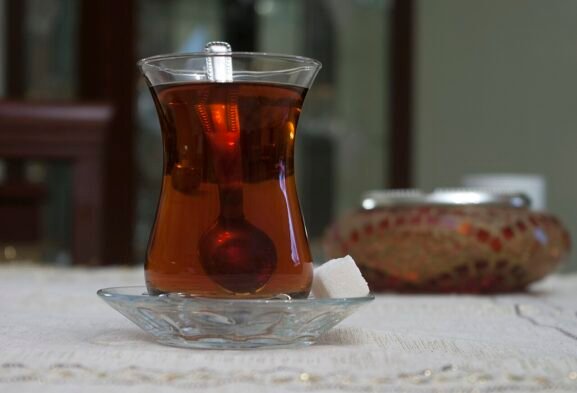
The classic pairing is a small cup of Turkish coffee with a piece of lokum on the saucer. It also belongs on a tea tray with a glass of Turkish tea, and a few cubes next to a slice of baklava make a generous dessert plate.
Where to eat lokum in London
Turkish patisseries and dessert shops in London sell lokum by weight, often in flavours from rose to pomegranate and double pistachio. Browse our desserts and baklava listings, look in our Turkish grocers and delis for boxed lokum, or read our guide to the best baklava in London.
- The Baklava Company – Turkish desserts & baklava in Whitechapel
- Mazlum London 1924 – Turkish desserts & baklava in Knightsbridge
- Bebek Baklava – Turkish desserts & baklava in Dalston & Stoke Newington
- Mersin Tantuni – Turkish desserts & baklava in Dalston & Stoke Newington
- Gaziantep Pastanesi – Turkish bakery & börek in Edmonton
- Neco Tantuni ve Künefe – Turkish desserts & baklava in Enfield
See all 15 Desserts & Baklava places in London
Lokum FAQs
Is lokum the same as Turkish delight?
Yes. Lokum is the Turkish name; Turkish delight is the English one.
Why didn’t my Turkish delight set?
The syrup did not reach 115°C, or the combined mixture was not cooked long enough. It needs to be very thick and pale gold before you pour it.
Can I make lokum without cream of tartar?
Yes. Replace it with 1 to 2 teaspoons of lemon juice in the starch mixture. The acid helps keep the texture soft.
Photo: Maksym Kozlenko, CC BY-SA 4.0, via Wikimedia Commons.