Best baklava: how to tell good baklava from bad
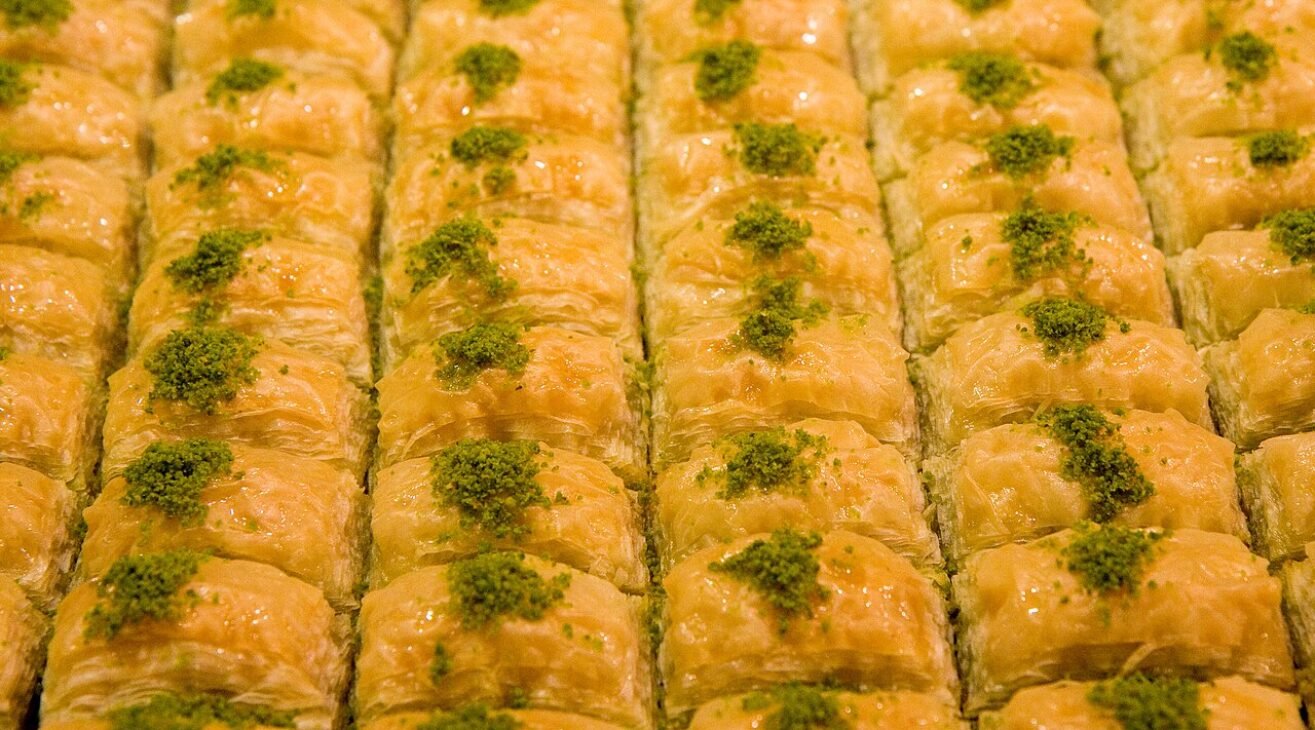
Good baklava is crisp, not soggy. The layers should crackle when you cut them, the pastry should have a glossy yellow shine from proper butter, the pistachios should be bright green, and the syrup should sweeten without swimming in the tray. If a piece bends, drips or smells of nothing much, walk on.
Below are seven quick checks you can make at any counter, then how baklava is sold in London, the shapes you will see in the case, and why Gaziantep matters.
A baklava checklist: how to tell good from bad
1. Look at the colour
You want a vivid golden yellow with a sheen. Dull, pale or brownish pastry has usually been sitting a while, or was made with cheaper fat. Ask when the tray came out.
2. Listen for the crunch
A fork should go in with an audible crack. If the piece squashes or folds, it has soaked up too much syrup or is past its best.
3. Look at the layers
Turkish baklava is made from yufka rolled so thin you could almost read through it. A Gaziantep tray has around 40 layers, and you should be able to see them as fine lines on the cut edge. Thick, doughy layers mean a cheaper pastry.
4. Check the pistachios
The filling should be a bright, almost emerald green. That colour comes from young pistachios picked early, and they taste better too. Brownish or pale nuts are older or a lower grade, and a good shop will never pad the filling with peanuts.
5. Judge the syrup
Lift a piece. It should not drip, and there should be no puddle in the tray or on your plate. Turkish baklava uses a sugar syrup, not honey, and the best is sweet without being cloying.
6. Smell the butter
Good baklava smells of browned butter before you taste it. A flat or greasy taste usually means margarine or vegetable fat.
7. Ask how fresh it is
Syrup baklava keeps for a couple of weeks, but it is at its best on the day it is made, and the bottom layers soften day by day. In a busy shop, ask which tray is today’s.
Buying baklava in London
London shops sell baklava by weight, usually by the kilo or half kilo, and some also sell single portions to eat in with tea. Pistachio baklava (fıstıklı) costs more than walnut (cevizli), because the nuts do. If you cannot decide, ask for a mixed box (karışık), and do not be shy about asking to taste a piece first; in a proper baklava shop that is normal. Check whether the box is from today’s trays, and if you are carrying it home, keep it flat and out of the fridge, which makes the pastry go hard.
Start with the dessert and baklava places on Turkish Dish, and see our guide to the best baklava in London for a longer list by area.
Gaziantep baklava and its EU protection
Gaziantep, in south-eastern Türkiye, is the city most tied to baklava, and the pistachio is even named after it: Antep fıstığı. In 2013 the EU registered Antep Baklavası as a Protected Geographical Indication, the first Turkish product to get EU protection. Its modern form was refined in the Ottoman palace kitchens in Istanbul, though layered nut pastries are older than that, and several countries claim them.
Shapes and styles you will see
- Kare (square): the classic cut, usually pistachio.
- Havuç dilimi (carrot slice): long wedges cut from a round tray, so they look like carrots.
- Şöbiyet: triangles with kaymak or a semolina and milk cream inside the pistachios. Richer than plain baklava, and best eaten the day it is made.
- Fıstık dolama or dürüm (pistachio wrap): a roll of very thin pastry packed with pistachios.
- Kuru baklava (dry baklava): less syrup, so it is crisper and keeps longer. A good one to take home.
- Saray burması (palace baklava): a rolled, coiled style, usually pistachio in Antep-style shops, though you will see walnut versions.
- Kadayıf-based sweets: not baklava, but a separate family made from shredded pastry and soaked in syrup.
Try our baklava recipe to see how the layers go together, or our künefe recipe for a shredded-pastry dessert.
How to eat it
Turkish baklava makers will tell you to turn a piece upside down so the crisp top hits your tongue first, and to eat it in one or two bites rather than sawing at it with a fork. Have it with strong black tea or a Turkish coffee, which cut the sweetness. In summer, a scoop of Maraş ice cream on the side is a common treat.
Our pick: Şehr-i Antep Enfield, Ponders End
A family-owned baklava and cake shop on the High Street in Ponders End, focused on Antep-style baklava. Its listing names fıstıklı kare, cevizli, dürüm and kuru baklava, so you can compare pistachio, walnut and drier, crisper styles side by side, with a çay to go with them. See Şehr-i Antep Enfield on Turkish Dish.
- Kahve Dünyası Piccadilly – Turkish desserts & baklava in Soho & West End
- Ayintap Pastanesi – Turkish bakery & börek in Edmonton
- AntepHan Baklava & Künefe – Turkish desserts & baklava in Enfield
- Şehr-i Antep Enfield – Turkish desserts & baklava in Enfield
- Mehmet Efendi 1953 Whitechapel – Turkish desserts & baklava in Whitechapel
- Hafız Mustafa 1864 Knightsbridge – Turkish desserts & baklava in Knightsbridge
See all 15 Desserts & Baklava places in London
Baklava questions, answered
How do you know if baklava is good quality?
Crisp, thin layers; a glossy yellow colour; a smell of butter; bright green pistachios; and syrup that stays in the pastry rather than in the tray.
Is baklava supposed to be soggy?
No. It should be soaked through but still crisp. Soggy baklava has had too much syrup or been kept too long.
Should I keep baklava in the fridge?
No. The cold hardens the butter and the syrup turns the pastry chewy. Keep it covered at room temperature and eat it within a few days.
What is the difference between baklava and şöbiyet?
Şöbiyet has a layer of kaymak or semolina cream with the nuts, which makes it richer and softer. It does not keep, so eat it the day you buy it.
Photo: Garrett Ziegler, CC BY-SA 4.0, via Wikimedia Commons.