
Turkish vs Greek food: what’s the same and what’s different
Turkish and Greek food are close relatives. Centuries of shared history in the Ottoman world left them with many of the same dishes under different names (dolma and dolmades, cacık and tzatziki, döner and gyros), and the same habit of eating lots of small plates with a drink. The differences are in the seasoning, the meat, the cheese and what is in the glass.
Five pairs of dishes
Dolma and dolmades
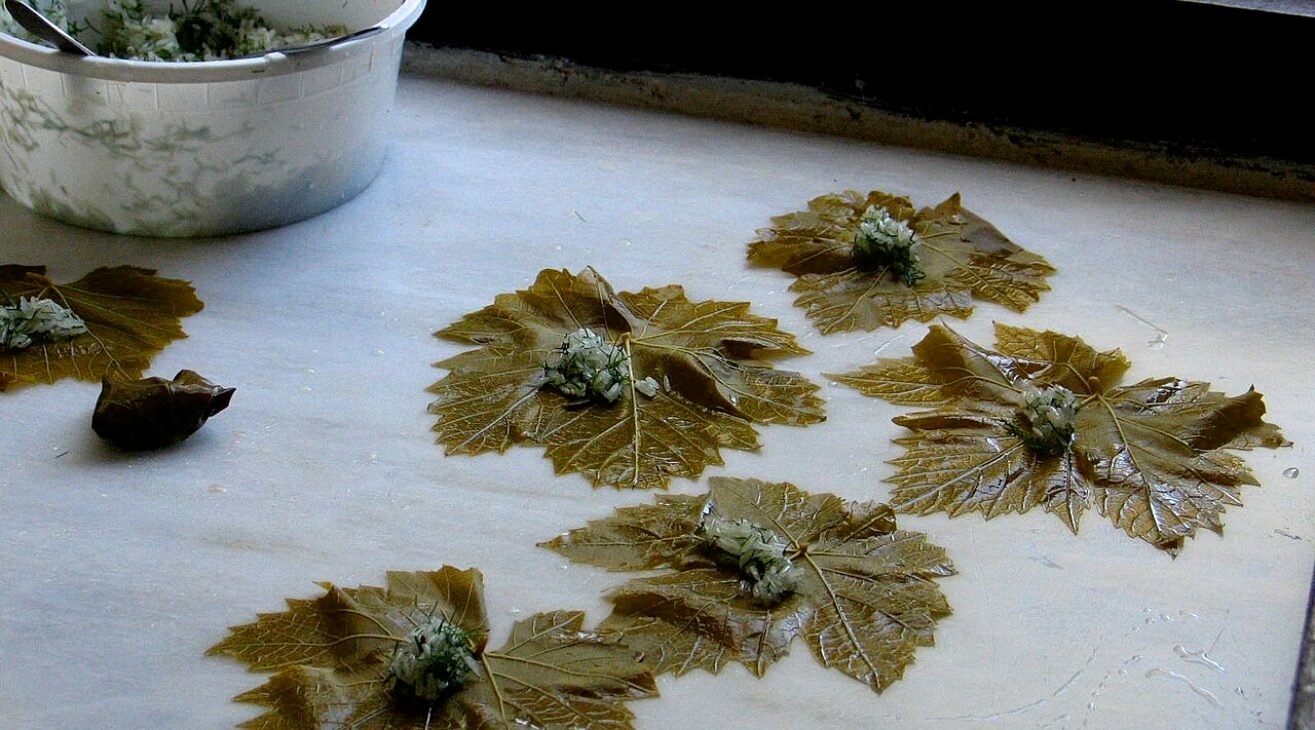
Vine leaves rolled round herby rice and cooked in olive oil are almost identical in both countries; the Turkish version often has currants and pine nuts, the Greek one more lemon and dill. The word comes from the Turkish doldurmak, “to fill”. See our yaprak sarma recipe.
Cacık and tzatziki
Both are yoghurt, cucumber and garlic. Tzatziki is usually thick, made with strained yoghurt and finished with olive oil, while Turkish cacık is often thinned with water and flavoured with dried mint and dill, so you eat it with a spoon. For a thick Turkish yoghurt meze, try our haydari recipe.
Imam bayıldı, karnıyarık and papoutsakia
Imam bayıldı (aubergine stuffed with onion and tomato, cooked in olive oil) is made on both sides of the Aegean. Karnıyarık stuffs the aubergine with spiced mince instead; the Greek papoutsakia (“little shoes”) does the same but adds a béchamel topping. See the imam bayıldı and karnıyarık recipes.
Çoban salatası and horiatiki
The Turkish “shepherd’s salad” is finely chopped tomato, cucumber, pepper, onion and parsley with lemon and olive oil. The Greek village salad is cut in chunks and topped with a slab of feta and oregano.
Kuru fasulye and fasolada
Both are white bean stews with onion, tomato and olive oil. The Greek version often has celery and carrot and is usually meat-free; the Turkish one is often cooked with a little lamb or pastırma and eaten with rice and pickles.
Baklava belongs to both, too. Several countries claim it; the Turkish version is usually pistachio with a sugar syrup, the Greek one walnut, often with honey and cinnamon. Our baklava recipe shows the Turkish way.
Döner vs gyros
Both are meat cooked on a vertical spit and shaved off. Turkish döner is lamb, beef or chicken; Greek gyros is very often pork, served in a pitta with chips and tzatziki. Our guide to döner, shawarma and gyros explains the rest, and our döner kebab recipe shows how to make it at home.
Where they really differ
Spices and herbs
Turkish cooking reaches for chilli flakes (pul biber), sumac, cumin and dried mint; Greek cooking for oregano, dill, lemon and bay, with cinnamon in meat stews. Both use mint and garlic generously. The sliced onions beside a Turkish kebab, dusted dark red with sumac, are a good example.
Meat
Pork is central to a lot of Greek cooking and absent from Turkish cooking, where lamb, beef and chicken do the work.
Cheese
Turkey’s beyaz peynir (“white cheese”) is a brined cheese close to feta, made from sheep, cow or goat milk. Greece has feta itself, with protected status, plus graviera and kefalotyri. Hellim (halloumi) is shared by both Cypriot communities.
Drinks
Rakı is an aniseed spirit distilled from grapes, about 45% alcohol, close to Greek ouzo. Both are drunk with cold water, which turns them milky, and both go with meze and fish.
Where to taste the overlap in London
The overlap is clearest in north London’s Turkish Cypriot restaurants, where hellim, kleftiko and moussaka sit on the same menu as Adana and İskender. A meze table is the easiest way to compare: order cacık, dolma and a salad and see what you notice. Browse the Turkish restaurant list, start with our guide to popular Turkish dishes, and try the Turkish seafood restaurants for rakı and fish.
Our pick for this comparison is a Turkish grill with a Cypriot side to its menu rather than a Greek restaurant, because that is where the two traditions meet most naturally in London.
Our pick: Cyprus Mangal, Pimlico
A Turkish grill restaurant on Warwick Way, a few minutes’ walk from Victoria station, with charcoal-grilled dishes, meze and Cypriot cheese. The menu includes hellim and kleftiko, two dishes that make the overlap between Turkish and Cypriot cooking easy to taste. See Cyprus Mangal on Turkish Dish.
Turkish vs Greek food: common questions
Is Greek food the same as Turkish food?
No, but they are close relatives. They share many dishes and ingredients, and differ mainly in spices, meat and cheese.
What is the difference between tzatziki and cacık?
Tzatziki is thick and usually finished with olive oil; cacık is often thinned with water and flavoured with dried mint. Both are cucumber, yoghurt and garlic.
Is döner the same as gyros?
Same method, different meat. Döner is lamb, beef or chicken; gyros is often pork.
Is rakı the same as ouzo?
They are close cousins: both are aniseed spirits that turn milky with water. Rakı is distilled from grapes and is usually a little stronger.
Photo: Heidi Bauer, CC BY-SA 2.5, via Wikimedia Commons.

