
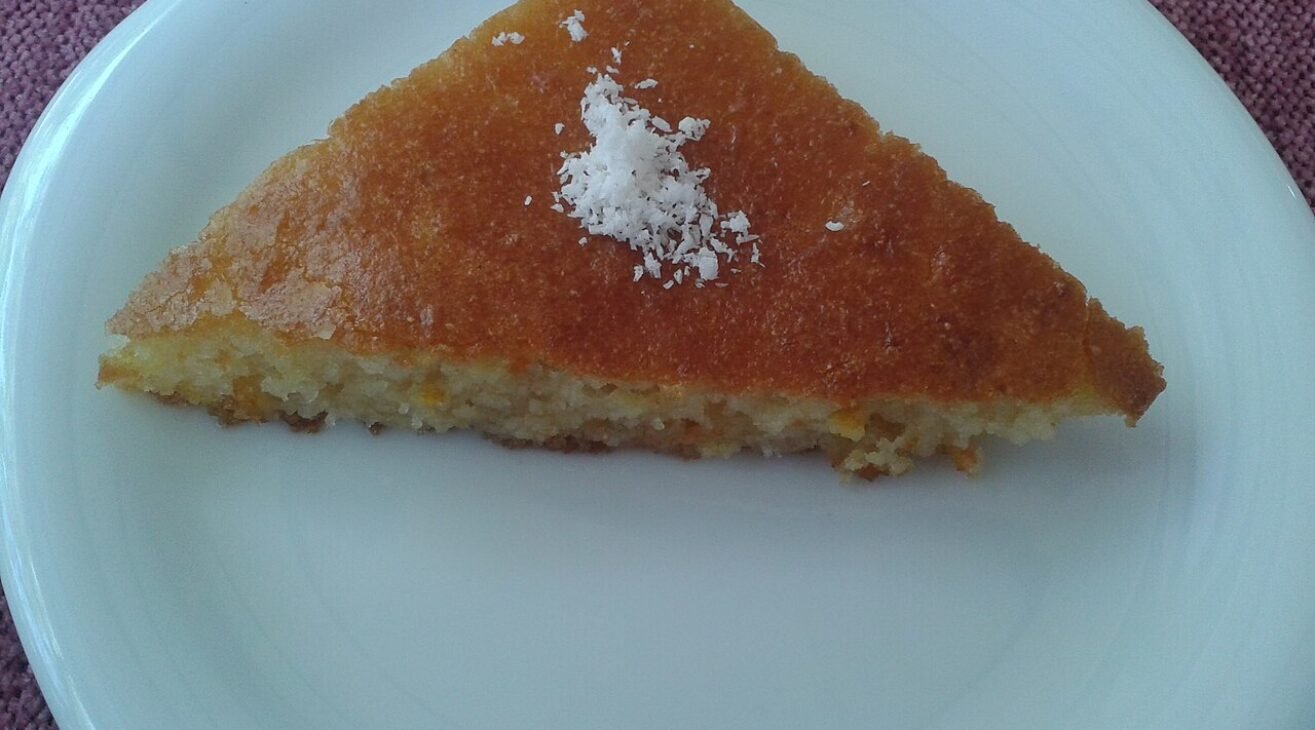
Revani recipe: Turkish semolina cake soaked in lemon syrup
Revani is the cake that turns up on Turkish tea tables, at family gatherings and in the display cases of every pastane (patisserie). It is a soft sponge made with semolina, baked in a tray and drenched in lemony sugar syrup while it is still hot from the oven. The result is moist all the way through without being heavy, and the semolina gives it a faint, pleasant grain that plain sponge lacks.
It is also one of the easiest syrup desserts to make at home. There is no pastry to roll and no frying, just a bowl, a whisk and a baking tin. Versions of the same idea are eaten from the Balkans to Egypt, where it is known as basbousa, as the Wikipedia entry on revani and basbousa explains, but the Turkish style tends to be lighter and more cake-like, often finished with desiccated coconut or crushed pistachios.
What is revani?
Revani is a semolina cake soaked in şerbet (sugar syrup). Food historians trace semolina syrup cakes back through the Arab and Ottoman kitchens, and an Ottoman Turkish cookbook printed in 1844, Melceü’t-Tabbâhîn, already gives a revani of baked semolina, butter, sugar and eggs, soaked in syrup and cut into baklava-style diamonds. The name is usually traced to a Persian word for oil or butter; a popular story instead links it to Revan (today’s Yerevan) and an Ottoman campaign under Murad IV.
Turkish revani today
Modern Turkish home cooks usually make revani with eggs, yoghurt and baking powder, which gives a taller, airier cake than the dense older versions. Lemon or orange zest goes into the batter, and the syrup is flavoured with lemon juice and peel. Coconut on top is very common; pistachio is the smarter bakery finish, and some cooks serve squares with a spoonful of kaymak (clotted cream).
Neighbouring versions
Across the region the same cake goes by many names: basbousa in Egypt, harisa or namoura in the Levant, and şambali in İzmir, while Greek Cypriots call it shamali. Some are made with coconut in the batter, some with rose or orange-blossom water in the syrup, and some are denser and nuttier. Revani is listed among the standard Turkish semolina desserts in the Wikipedia overview of Turkish cuisine.
Ingredients
Serves 12. You will need a 20 x 30cm baking tin, about 5cm deep.
For the syrup
- 500g granulated sugar
- 600ml water
- 1 tbsp lemon juice
- 1 strip of lemon peel
For the cake
- 4 large eggs, at room temperature
- 150g caster sugar
- 200g full-fat plain yoghurt
- 120ml sunflower oil
- Finely grated zest of 1 lemon
- 170g fine semolina
- 100g plain flour
- 2 tsp baking powder
- A pinch of salt
To finish
- 3 tbsp desiccated coconut or 2 tbsp finely chopped pistachios
How to make revani
1. Make the syrup first
Put the sugar, water and lemon peel in a pan and bring to the boil, stirring until the sugar dissolves. Simmer for 10 minutes, add the lemon juice, then take it off the heat and leave it to cool completely. Cold syrup on a hot cake is the rule that makes revani moist rather than soggy.
2. Prepare the tin and oven
Heat the oven to 180°C (160°C fan). Grease the tin with a little oil and line the base with baking paper.
3. Whisk the eggs and sugar
Beat the eggs and caster sugar with an electric whisk for 4 to 5 minutes, until pale, thick and roughly doubled in volume. This is where most of the lift comes from, so do not rush it.
4. Add the wet ingredients
Whisk in the yoghurt, oil and lemon zest on a low speed until just combined.
5. Fold in the dry ingredients
Mix the semolina, flour, baking powder and salt in a separate bowl, then fold them into the egg mixture with a spatula in two or three goes. Stop as soon as there are no dry streaks. The batter will be fairly loose.
6. Bake
Pour the batter into the tin, level it and bake for 30 to 35 minutes, until golden and a skewer pushed into the centre comes out clean.
7. Soak and rest
As soon as the cake comes out of the oven, cut it into squares or diamonds in the tin. Ladle the cold syrup evenly over the hot cake; it will hiss and seem like too much, but it all goes in. Leave to cool and soak for at least 2 hours, then scatter over the coconut or pistachio before serving.
Watch: how to make revani
This video shows the whisking, baking and syrup soak step by step.
Tips for the best revani
- Keep the temperatures opposite: cold syrup on a hot cake, or warm syrup on a cooled cake. Hot on hot turns the crumb to mush.
- Use fine semolina, not coarse. Coarse semolina stays gritty after baking.
- Cut the cake before you pour the syrup so it can run down every side of each piece.
- Revani is better the next day. Cover it and keep it at cool room temperature for up to two days, or in the fridge for four.
- For an orange version, swap the lemon zest and peel for orange, and add a teaspoon of orange-blossom water to the cooled syrup.
What to serve with revani
Revani is an afternoon cake, so serve it with a glass of properly brewed Turkish tea or a small cup of Turkish coffee. If you are putting together a dessert spread, it sits well next to crisp şekerpare biscuits and a cool, creamy sütlaç rice pudding.
Where to eat revani in London
Most Turkish patisseries and dessert cafés in London keep a tray of revani alongside the baklava. Browse our Turkish desserts and baklava listings to find one near you, and see our guide to the best baklava in London for more syrup-soaked sweets.
- Mehmet Efendi 1953 – Turkish desserts & baklava in Edgware Road & Marylebone
- Cafer Erol London 1807 – Turkish desserts & baklava in Knightsbridge
- Neco Tantuni ve Künefe – Turkish desserts & baklava in Enfield
- The Baklava Company – Turkish desserts & baklava in Whitechapel
- Mazlum London 1924 – Turkish desserts & baklava in Knightsbridge
- Mersin Tantuni – Turkish desserts & baklava in Dalston & Stoke Newington
See all 15 Desserts & Baklava places in London
Revani FAQs
Is revani the same as basbousa?
They are close relatives. Both are semolina cakes soaked in syrup, but Turkish revani is usually lighter and spongier, made with whisked eggs, while basbousa is often denser and may contain coconut in the batter.
Why is my revani soggy?
Usually because the syrup and cake were both hot, or the syrup was too thin. Cook the syrup for the full 10 minutes and let it cool completely before pouring.
Can I make revani without yoghurt?
Yes. Replace the yoghurt with the same weight of milk. The cake will be slightly less tender but still good.
Can I freeze revani?
It freezes well after soaking. Wrap squares tightly and freeze for up to a month, then thaw at room temperature.
Photo: E4024, CC BY-SA 4.0, via Wikimedia Commons.