Ayva tatlısı recipe: Turkish quince dessert with kaymak
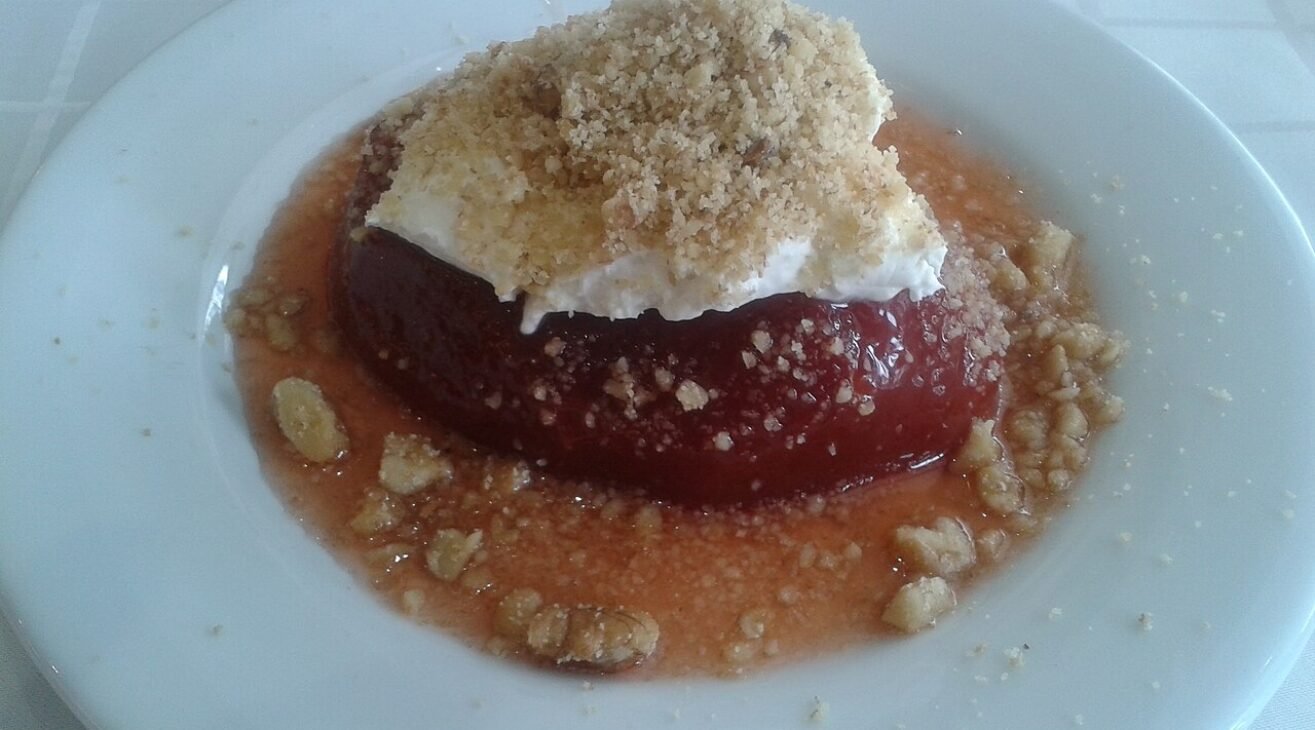
Ayva tatlısı is quince cooked slowly in sugar until the hard, pale, astringent fruit turns tender and a deep amber to rosy red. Nothing is added for colour. The change comes from time, sugar and gentle heat. It is served cold, with a spoonful of thick cream called kaymak and a scatter of chopped walnuts. It is one of the best desserts of the autumn, when quinces are in season.
Quinces grow widely in Turkey and the fruit is used in jams, compotes and savoury stews as well as in this dessert. In Istanbul, ayva tatlısı appears in the windows of dessert shops and on lokanta menus from October, when the first quinces arrive, and disappears again by spring. At home the only thing it asks for is patience: the fruit needs an hour or more to soften and turn red.
What is ayva tatlısı?
The name means quince dessert. Peeled quinces are halved, cored and cooked in a covered pan with sugar and a little water. The sugar draws out the fruit juice, and over the long cooking time this becomes a thick syrup. The flesh softens, turns translucent and gradually changes from creamy yellow to a rich red. When it is cold, it is spooned into a bowl with the syrup and topped with kaymak and walnuts. The taste is sweet and floral, with a slight tartness.
Choosing and preparing the quince
Quinces are in season in the UK from about October into December, and you will find them in Turkish grocers, farm shops and some greengrocers. Pick fruit that is firm and yellow with a strong perfume, and rub off the grey fuzz. They are very hard, so cut them with a sharp, heavy knife. Peel them, halve them and scoop out the core with a spoon or melon baller. Rub the cut surfaces with lemon straight away because they brown quickly. Keep the peels and cores for the pan, because they help colour and thicken the syrup.
Popular variations
A baked version cooks the quinces in the oven at a low heat in a covered dish. Some cooks stuff the hollow of each half with a spoonful of sugar and a clove before cooking. A few drops of lemon juice or a stick of cinnamon are common additions. Cooks who prefer a lighter sweetness use less sugar and cook for longer. Kaymak is the usual topping, but in the UK clotted cream is a good substitute, and whipped cream or thick yoghurt also work.
Ingredients
Serves 6, 1 quince half each. Chill for at least 2 hours before serving. Prep time: 20 minutes. Cooking time: 1 hour 15 minutes.
For the quince
- 3 large quinces (about 1kg)
- 300g caster sugar
- 400ml water
- Juice of 1/2 lemon, plus extra if needed
- 4 whole cloves (optional)
- 1 cinnamon stick (optional)
To serve
- 6 tbsp kaymak or clotted cream
- 50g walnuts, roughly chopped
How to make ayva tatlısı
1. Prepare the quinces
Rub the fuzz off the quinces under running water. Peel them with a vegetable peeler and keep the peels. Cut each quince in half from stalk to base and scoop out the core and seeds with a spoon, keeping them too. Rub the cut surfaces with some of the lemon juice straight away, and save the rest for the pan.
2. Line the pan
Use a wide pan with a lid that holds the halves in a single layer. Spread the peels and cores in the base of the pan. They add pectin and colour to the syrup. Place the quince halves on top, cut side up.
3. Add the sugar and water
Spoon the sugar into the hollows and over the fruit. Pour the water around the quinces, not over them, and add the rest of the lemon juice, the cloves and the cinnamon if using. Do not stir. The sugar will dissolve as the pan heats and the quinces release their juice, so do not worry if it looks dry at first.
4. Cook slowly, covered
Bring to a gentle simmer over medium heat, then cover and reduce to the lowest setting. Cook for 60 to 75 minutes, checking every 20 minutes and basting the fruit with the syrup. The quinces are ready when a knife slides in easily and the flesh is deep amber to red. Add a splash of hot water if the pan looks dry.
5. Reduce the syrup
Lift out the quinces with a slotted spoon onto a dish. Strain the syrup, discard the peels and cores, and boil the syrup in the pan for 5 to 8 minutes until it coats the back of a spoon. It will thicken more as it cools.
6. Chill and serve
Pour the syrup back over the fruit and cool to room temperature, then cover and refrigerate for at least 2 hours. Serve each half cold or at room temperature in a shallow bowl, with some of the syrup, a spoonful of kaymak or clotted cream on top and a scatter of chopped walnuts. The syrup should be thick and glossy.
Watch: how to make ayva tatlısı
A Turkish-language ayva tatlısı recipe made without food colouring, useful for seeing how red the fruit and syrup should become.
Tips for the best ayva tatlısı
- Do not add colouring. Time and low heat produce the deep red, and a lid keeps in the steam that does the work.
- Keep the heat low. A hard boil makes the outside mushy before the middle is tender.
- Cut off any dark, bruised patches before cooking, as they can taste bitter.
- Keep the peels and cores in the pan. They help the syrup set and improve its colour.
- Do not cook in an aluminium pan, which can dull the colour. Use stainless steel or enamelled cast iron.
- For a firmer result, check the fruit after 50 minutes and stop when a knife goes in with slight resistance.
What to serve with ayva tatlısı
Serve the quince cold or at room temperature with kaymak or clotted cream and chopped walnuts, with a glass of black Turkish tea. A spoonful of the syrup over the cream ties it together. It works well after a heavy meat dish, or as part of an autumn dessert table.
How to store ayva tatlısı
Keep the quince in its syrup in a covered container in the fridge for up to 5 days, adding the cream and walnuts only when serving. You can freeze it with the syrup for up to 2 months, but the texture softens a little after thawing.
Where to eat ayva tatlısı in London
We have not found a London listing that serves ayva tatlısı as a dessert, so this is one to make at home while quinces are in the shops. If you want to taste quince the Ottoman way when eating out, Deraliye serves ayva dolması, a savoury baked quince stuffed with spiced lamb, rice, pine nuts and currants. For sweet things, browse our dessert and baklava listings or the best Turkish restaurants in London.
- Şehr-i Antep Enfield – Turkish desserts & baklava in Enfield
- Mehmet Efendi 1953 Whitechapel – Turkish desserts & baklava in Whitechapel
- AntepHan Baklava & Künefe – Turkish desserts & baklava in Enfield
- Ayintap Pastanesi – Turkish bakery & börek in Edmonton
- Kahve Dünyası Piccadilly – Turkish desserts & baklava in Soho & West End
- Pera Artisan Patisserie – Turkish bakery & börek in Harringay & Green Lanes
See all 15 Desserts & Baklava places in London
Ayva tatlısı FAQs
Why is my ayva tatlısı not turning red?
It needs enough time, enough sugar and a tight lid. Quinces turn red only after an hour or more of slow cooking in a covered pan. Cooking uncovered, using too little sugar or cooking for too short a time will leave the fruit pale yellow. Some quinces also stay paler than others, so do not worry if yours is more amber than red.
Can I make it without kaymak?
Yes. Clotted cream is the closest widely available substitute in the UK, and mascarpone, whipped cream or thick strained yoghurt also work. Kaymak is available in Turkish grocers and has a rich, slightly tangy flavour that suits the sweet quince.
Can I bake ayva tatlısı instead?
Yes. Place the quinces, sugar and water in a deep ovenproof dish, cover tightly with foil and bake at 160°C (140°C fan) for 1 hour 30 minutes to 2 hours, basting once or twice, until a knife slides in easily. The result is very similar to the hob version.
Can I use pears or apples instead of quince?
They are not a good match. Pears and apples cook in 15 to 20 minutes and do not turn red, so the dessert will be quite different. If quinces are not available, wait for autumn, when they are in season, or use firm pears and poach them gently in the same syrup for a simpler pudding.
More Turkish recipes
- Aşure recipe: Noah’s pudding with grains, fruit and nuts
- Revani recipe: Turkish semolina cake soaked in lemon syrup
- Sütlaç recipe: Turkish baked rice pudding with a caramelised top
Photo: E4024, CC BY-SA 4.0, via Wikimedia Commons.